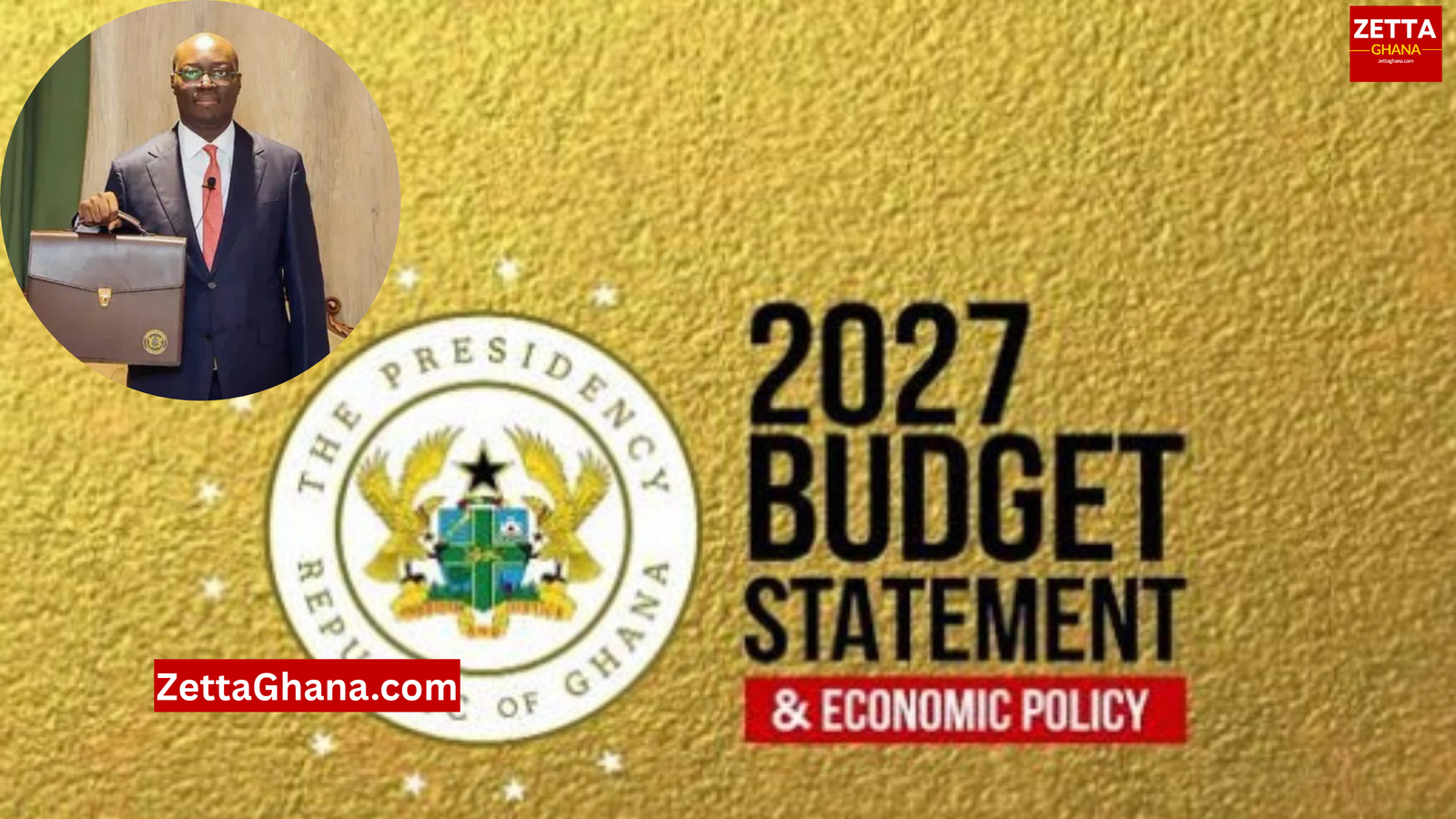
The government has unveiled a US$10 billion economic transformation programme covering eight pillars, with plans to increase local production, process more of Ghana’s natural resources and create jobs between 2027 and 2030.
Finance Minister Dr Cassiel Ato Forson announced the four-year New Economy Programme during the presentation of the 2027 Budget Statement and Economic Policy to Parliament on Thursday, November 12, 2026.
The initiative is intended to reduce Ghana’s dependence on raw material exports and imports by expanding local industries and strengthening the country’s productive capacity.
The eight pillars are macroeconomic stability and affordable finance, commercial agriculture, energy infrastructure, critical minerals processing, tourism and creative arts, textiles and garments, pharmaceuticals and biomanufacturing, and the technology economy.
1. Macroeconomic stability and affordable finance
The first pillar seeks to sustain economic stability while making financing more accessible to businesses.
The government plans to maintain a primary surplus of at least 0.5 per cent of GDP from 2027, keep public debt consistent with a 45 per cent of GDP target and preserve single-digit inflation.
By 2030, it is targeting real GDP growth of about 8 per cent, unemployment below 8 per cent and a credible path towards an investment-grade sovereign credit rating.
It also wants to reduce the cost of capital to single digits through improved bank lending, credit guarantees and longer-term financing arrangements.
2. Commercial agriculture
Commercial agriculture will receive US$3 billion to increase domestic food production and reduce reliance on imported agricultural products.
The investment will focus on eight value chains: rice, sugar, poultry, maize and soya feed, aquaculture, oil palm, vegetables and cocoa value addition.
Among the targets are achieving rice self-sufficiency, producing sugar locally by 2030, developing 100,000 hectares for oil palm cultivation and processing all cocoa locally by the end of the decade.
The government also plans to invest US$1 billion in the Pwalugu Multipurpose Dam to support irrigation and year-round vegetable production.
3. Energy infrastructure
The government has allocated US$2.2 billion to energy infrastructure, with the aim of providing reliable and affordable electricity for households and businesses.
Projects under this pillar include a 1,450-megawatt state-owned thermal power plant in the Central Region and a 600-megawatt solar power facility supported by battery storage.
Other planned investments include US$500 million for transmission network upgrades, the deployment of two million prepaid meters and private-sector participation in electricity distribution.
A further US$200 million will go towards a nuclear-readiness programme. The government wants to complete preparatory work and sign a construction and financing contract by December 2028.
It also aims to end its reliance on expensive emergency power plants by 2030.
4. Critical minerals value addition
Another US$1.5 billion will be invested in developing local processing capacity for manganese, bauxite, lithium and gold.
The government wants more of the value generated from Ghana’s mineral resources to remain in the country through local refining and processing rather than the export of raw materials.
Under the plan, at least 70 per cent of artisanal and small-scale gold is expected to be refined locally by December 2027. Raw small-scale gold exports are expected to be prohibited by December 2028.
The government also targets local processing of at least 50 per cent of manganese and bauxite by the end of 2028, with full processing targeted by 2030.
The pillar includes plans for a 24-hour critical minerals processing enclave in the Western Region and a railway connection between Takoradi and Nyinahin to transport minerals for processing.
5. Tourism, culture and creative arts
The tourism, culture and creative arts sector is expected to receive US$1 billion to increase foreign exchange earnings and generate employment.
The government plans to expand the Black Star Experience into a year-round programme, with heritage tourism, family reunions, ancestry services and creative arts forming part of efforts to attract visitors throughout the year.
Infrastructure projects include an international convention centre at the La Trade Fair Centre, five-star hotels in Accra and Kumasi, and four-star facilities along the Cape Coast and Elmina heritage corridor, in the Volta Region and in Northern Ghana.
The plans also include a Ghana Medical Tourism Hub and the completion of a new National Theatre in Kumasi.
6. Textiles and garments
The government has earmarked US$1 billion to revive the textile and garment industry and increase the international competitiveness of locally produced fabrics and clothing.
The investment will support the modernisation of existing factories, the development of industrial infrastructure and increased production capacity.
New and upgraded production lines are expected to begin operating in 2028, supported by buyer agreements and export orders.
By 2030, the government wants Ghana to have a commercially competitive industry supplying both local and international markets.
The expansion is expected to create jobs for designers, dressmakers, machine operators, technicians and factory workers, particularly women and young people.
7. Pharmaceuticals and biomanufacturing
A further US$1 billion will go towards pharmaceutical production and biomanufacturing to reduce dependence on imported medicines and strengthen Ghana’s health security.
Dr Forson said the country currently imports between 70 and 75 per cent of its medicine requirements at an annual cost of about US$500 million.
The government plans to establish pharmaceutical and biomanufacturing hubs in the Eastern and Central Regions.
It will also give preference to locally manufactured medicines in public procurement where they are available in sufficient quantities and meet approved quality standards.
The target is to produce between 60 and 80 per cent of Ghana’s essential medicine needs locally by 2030. The sector is also expected to generate about 20,000 direct and indirect jobs.
8. Technology economy
The final pillar has an allocation of US$300 million for 2027 and 2028 to establish a National Artificial Intelligence Centre and upgrade rural 2G networks to reliable 4G connectivity.
The proposed centre will provide computing facilities, research laboratories, secure data environments, professional training and support for start-ups.
Its priority areas will include agriculture, healthcare, energy, mining, logistics, Ghanaian languages and public services.
The government also intends to equip young people with practical skills in software development, data analytics, artificial intelligence, digital networks and digital business services.
The initiative is expected to widen access to digital opportunities, especially for people and businesses outside major urban centres.
Funding and implementation
The US$10 billion programme will be financed through measures including adjustments to the government's primary surplus target, revenue from tax reforms and improved compliance.
The government says public resources will support strategic infrastructure and productive investments, while private businesses are expected to lead investment, innovation, production and sustainable job creation.
It has also pledged to make government support transparent, time-bound and tied to measurable results.
The broader objective is to use Ghana’s economic recovery to expand its productive base, create employment and ensure that more of the value from the country’s resources is generated locally.